
A Global Journey Through the Vineyards That Define Wine
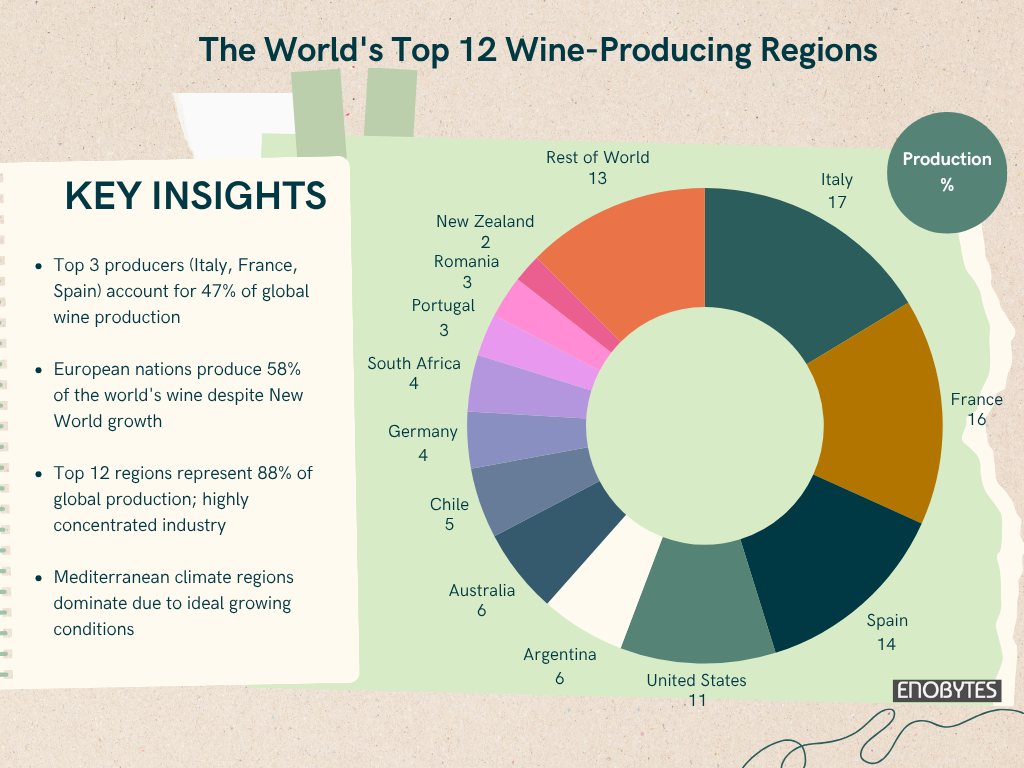
Wine production is concentrated in a surprisingly small number of countries, with the top twelve accounting for roughly 90% of global output. These regions represent not just volume but centuries of winemaking tradition, diverse terroirs, and the grapes that have come to define wine culture worldwide. Understanding these regions provides context for nearly every bottle you’ll encounter, from everyday table wine to the most prestigious labels.
1. Italy (16-18% of Global Wine Production)
Italy is the world’s largest or second-largest wine producer depending on the year, locked in an ongoing battle with France for the top position. What sets Italy apart is its extraordinary diversity—over 350 registered grape varieties and 73 DOCG (Denominazione di Origine Controllata e Garantita) designations representing the highest quality tier.
Key Grapes: Sangiovese, Nebbiolo, Barbera, Montepulciano, Glera (Prosecco), Pinot Grigio, Trebbiano
Major Regions & Appellations:
- Tuscany: Chianti, Brunello di Montalcino, Vino Nobile di Montepulciano, Bolgheri (Super Tuscans)
- Piedmont: Barolo, Barbaresco, Barbera d’Asti, Moscato d’Asti
- Veneto: Prosecco, Valpolicella, Amarone, Soave
- Sicily: Nero d’Avola, Etna DOC
Interesting Fact: Italy has more indigenous grape varieties than any other country, and some Italian wines (like Amarone della Valpolicella) are made from grapes that are dried for months before fermentation, concentrating sugars and flavors in a process called appassimento.
2. France (15-17% of Global Wine Production)
France may produce slightly less wine than Italy by volume, but it maintains unmatched prestige and influence. French wine regions established the classification systems, winemaking techniques, and grape varieties that the rest of the world emulates. The AOC (Appellation d’Origine Contrôlée) system, now the EU-wide AOP, originated here and became the model for quality wine designation globally.
Key Grapes: Cabernet Sauvignon, Merlot, Pinot Noir, Chardonnay, Sauvignon Blanc, Syrah, Grenache
Major Regions & Appellations:
- Bordeaux: Left Bank (Médoc, Pauillac, Margaux), Right Bank (Pomerol, Saint-Émilion)
- Burgundy: Côte d’Or (Gevrey-Chambertin, Chambolle-Musigny, Puligny-Montrachet), Chablis, Beaujolais
- Champagne: Montagne de Reims, Vallée de la Marne, Côte des Blancs
- Rhône Valley: Northern Rhône (Hermitage, Côte-Rôtie), Southern Rhône (Châteauneuf-du-Pape)
- Loire Valley: Sancerre, Pouilly-Fumé, Chinon, Vouvray
- Alsace: Riesling, Gewürztraminer, Pinot Gris
Interesting Fact: Burgundy’s Grand Cru vineyards are so meticulously classified that plots separated by a single stone wall can command prices that differ by tens of thousands of dollars per bottle, based purely on terroir differences measured in feet rather than miles.
3. Spain (13-15% of Global Wine Production)
Spain has more vineyard acreage than any country in the world, though dry conditions and low yields mean it ranks third in production volume. Spanish wine has undergone a dramatic quality revolution in the past 30 years, moving from bulk production to serious, age-worthy wines that compete globally while maintaining distinctly Spanish character.
Key Grapes: Tempranillo, Garnacha (Grenache), Monastrell, Albariño, Verdejo, Airén, Macabeo
Major Regions & Appellations:
- Rioja: Rioja Alta, Rioja Alavesa, Rioja Oriental
- Ribera del Duero: Tempranillo-based reds with international recognition
- Priorat: Intense, mineral-driven reds from slate soils
- Rías Baixas: Albariño whites from Galicia
- Jerez: Sherry production (Fino, Manzanilla, Oloroso, Pedro Ximénez)
- Penedès: Cava production, still wines
Interesting Fact: Spain’s sherry production uses the solera system, where wines from different vintages are blended in a fractional aging process that can involve barrels dating back over a century, making it impossible to assign a vintage date to the final product.
4. United States (10-11% of Global Wine Production)
The United States is the fourth-largest producer globally, with California accounting for roughly 85% of American wine production. While California dominates, serious wine production now spans from New York to Oregon to Texas, with American wine competing at the highest quality levels while also producing vast quantities of inexpensive wine for the domestic market.
Key Grapes: Cabernet Sauvignon, Chardonnay, Pinot Noir, Zinfandel, Merlot, Sauvignon Blanc
Major Regions & Appellations:
- California: Napa Valley (Oakville, Rutherford, Stags Leap), Sonoma (Russian River Valley, Dry Creek, Alexander Valley), Central Coast (Paso Robles, Santa Barbara)
- Oregon: Willamette Valley (Pinot Noir focus)
- Washington: Columbia Valley, Walla Walla Valley
- New York: Finger Lakes, Long Island
Interesting Fact: The 1976 Judgment of Paris, where California wines beat French wines in a blind tasting, shocked the wine world and legitimized New World wine production. The event was so controversial that one French judge demanded her scores be returned, claiming the tasting was rigged.
5. Argentina (5-6% of Global Wine Production)
Argentina is the largest wine producer in South America and the fifth-largest globally. The country’s high-altitude vineyards, particularly in Mendoza, produce wines with intense concentration and ripe fruit character. Malbec, once a minor blending grape in Bordeaux, found its true home in Argentina and has become the country’s signature variety.
Key Grapes: Malbec, Bonarda, Cabernet Sauvignon, Torrontés, Chardonnay
Major Regions & Appellations:
- Mendoza: Luján de Cuyo, Maipú, Valle de Uco (high-altitude sites)
- Salta: Cafayate (highest vineyards, Torrontés stronghold)
- San Juan: Bulk production and value wines
- Patagonia: Cooler-climate Pinot Noir and Malbec
Interesting Fact: Some of Argentina’s vineyards in the Uco Valley are planted at elevations exceeding 5,000 feet higher than any European vineyard, where the extreme altitude creates massive diurnal temperature swings that preserve acidity while allowing full ripeness.
6. Australia (5-6% of Global Wine Production)
Australia punches above its weight in the global wine market, known for bold, fruit-forward wines and innovative winemaking techniques. The country pioneered screw caps for quality wine, revolutionized technical winemaking, and created powerful, accessible wine styles that found enormous success in export markets, particularly Shiraz.
Key Grapes: Shiraz (Syrah), Cabernet Sauvignon, Chardonnay, Pinot Noir, Riesling, Grenache
Major Regions & Appellations:
- Barossa Valley: Powerful Shiraz, old-vine Grenache
- McLaren Vale: Rich Shiraz and Grenache
- Coonawarra: Cabernet Sauvignon on terra rossa soil
- Margaret River: Bordeaux-style blends, Chardonnay
- Yarra Valley: Cool-climate Pinot Noir and Chardonnay
- Clare Valley: Riesling
- Hunter Valley: Sémillon, Shiraz
Interesting Fact: Some of Australia’s Shiraz vines are over 170 years old, making them among the oldest producing vines in the world. These gnarly, low-yielding vines produce wines of extraordinary concentration and complexity, selling for hundreds of dollars per bottle.
7. Chile (4-5% of Global Wine Production)
Chile’s geography, trapped between the Andes Mountains and the Pacific Ocean, creates diverse microclimates ideal for viticulture. The country’s isolation also means it escaped phylloxera, so Chilean vines grow on their own rootstocks, making Chile one of the few wine regions where pre-phylloxera viticulture continues unchanged.
Key Grapes: Cabernet Sauvignon, Carmenère, Merlot, Sauvignon Blanc, Chardonnay, Syrah, Pinot Noir
Major Regions & Appellations:
- Maipo Valley: Cabernet Sauvignon near Santiago
- Colchagua Valley: Red wine focus, warm climate
- Casablanca Valley: Cool-climate whites and Pinot Noir
- Limarí Valley: High-altitude, coastal influence
- Elqui Valley: Northern, dessert wine production
Interesting Fact: For decades, what Chile thought was Merlot was actually Carmenère, a Bordeaux variety thought extinct after phylloxera. The mistake wasn’t discovered until 1994, and Carmenère has since become Chile’s signature grape.
8. Germany (3-4% of Global Wine Production)
Germany produces relatively small quantities of wine but maintains outsized influence, particularly for white wine. German Riesling is considered among the world’s greatest white wines, and the country’s Prädikat system for classifying wine by ripeness levels influenced quality designations worldwide. Despite its northerly latitude, Germany’s combination of slate soils and river valleys creates ideal conditions for aromatic whites.
Key Grapes: Riesling, Müller-Thurgau, Pinot Noir (Spätburgunder), Pinot Gris (Grauburgunder), Silvaner
Major Regions & Appellations:
- Mosel: Steep slate slopes, mineral Riesling
- Rheingau: Classic Riesling, full-bodied styles
- Pfalz (Palatinate): Warmer, diverse production
- Baden: Germany’s warmest region, Pinot Noir focus
- Franken: Silvaner, distinctive Bocksbeutel bottles
Interesting Fact: Germany’s Mosel Valley contains some of the steepest vineyards in the world, with slopes reaching 65-70 degrees. Viticulture here requires such dangerous work that vineyard laborers use ropes and specialized equipment, making these wines incredibly labor-intensive to produce.
9. South Africa (4% of Global Wine Production)
South African wine production was isolated during the apartheid era but has exploded in quality and diversity since the 1990s. The country’s Cape Winelands benefit from maritime influence and diverse soils, producing everything from Bordeaux-style blends to distinctive Chenin Blanc. Pinotage, a uniquely South African grape, was created here through a cross of Pinot Noir and Cinsault.
Key Grapes: Chenin Blanc, Cabernet Sauvignon, Pinotage, Sauvignon Blanc, Shiraz, Chardonnay
Major Regions & Appellations:
- Stellenbosch: Premium red wines, Bordeaux blends
- Paarl: Diverse production, Rhône-style wines
- Constantia: Cool-climate whites, historic sweet wines
- Swartland: Old-vine Chenin Blanc and Rhône varieties
- Walker Bay/Hemel-en-Aarde: Cool-climate Pinot Noir and Chardonnay
Interesting Fact: South Africa’s Constantia wine estate produced a legendary sweet Muscat wine in the 18th and 19th centuries that was considered the world’s greatest dessert wine, favored by Napoleon, Jane Austen, and European royalty. The tradition was revived in the 1980s and continues today.
10. Portugal (3% of Global Wine Production)
Portugal maintains winemaking traditions that date back millennia while producing distinctive wines found nowhere else. The country’s strength lies in indigenous grape varieties—over 250 native varieties—and unique wine styles like Port, Madeira, and Vinho Verde. Portuguese wine offers exceptional value and character that’s increasingly recognized internationally.
Key Grapes: Touriga Nacional, Touriga Franca, Tinta Roriz (Tempranillo), Alvarinho, Arinto, Baga
Major Regions & Appellations:
- Douro Valley: Port production, high-quality table wines
- Dão: Elegant reds, high-altitude vineyards
- Alentejo: Fuller-bodied reds, warm climate
- Vinho Verde: Light, slightly sparkling whites and reds
- Madeira: Fortified wine production
- Bairrada: Baga-based reds, traditional method sparkling
Interesting Fact: Madeira wine was accidentally created when fortified wine survived (and improved from) months-long sea voyages through tropical heat in ship holds. This discovery led to an intentional aging process using heat (estufagem) that makes Madeira virtually indestructible—opened bottles can last decades.
11. Romania (2-3% of Global Wine Production)
Romania has a long winemaking history dating to ancient times and was once a significant European producer. Under communism, the focus shifted to quantity over quality, but recent privatization and investment have sparked a quality renaissance. Romania’s indigenous varieties and diverse terroirs are being rediscovered by the international wine community.
Key Grapes: Fetească Neagră, Fetească Regală, Fetească Albă, Tămâioasă Românească, Riesling Italico, international varieties
Major Regions & Appellations:
- Dealu Mare: Red wine production, Pinot Noir
- Murfatlar: Black Sea influence, diverse production
- Cotnari: Historic white wine region
- Târnave: White wine focus, cool climate
- Recaș: Modern production, international varieties
Interesting Fact: Romania has extensive vineyard plantings (one of Europe’s largest by acreage) and a winemaking tradition older than France’s, but most Romanian wine is consumed domestically, making it one of Europe’s best-kept secrets for wine value and indigenous varieties.
12. New Zealand (1-2% of Global Wine Production)
New Zealand is small in production volume but massive in influence, particularly for Sauvignon Blanc. The country’s maritime climate, clean environment, and intense UV light create distinctive wine styles, especially the pungent, tropical Sauvignon Blanc from Marlborough that redefined the variety globally. New Zealand also produces world-class Pinot Noir from Central Otago and other cool-climate regions.
Key Grapes: Sauvignon Blanc, Pinot Noir, Chardonnay, Pinot Gris, Riesling, Syrah
Major Regions & Appellations:
- Marlborough: Sauvignon Blanc dominance (77% of NZ production)
- Central Otago: World’s southernmost wine region, premium Pinot Noir
- Hawke’s Bay: Bordeaux-style reds, diverse production
- Martinborough: Pinot Noir, small production
- Waipara: Cool-climate whites and Pinot Noir
Interesting Fact: New Zealand’s wine industry is remarkably young—serious commercial production began only in the 1970s. Yet within 50 years, New Zealand Sauvignon Blanc became so distinctive and popular that it now commands premium prices globally and has inspired imitators worldwide who try to capture its aggressive, tropical style.
Understanding Global Wine Production
The concentration of wine production in these twelve regions reflects both historical tradition and geographic suitability. The Mediterranean climate, with hot, dry summers and mild, wet winters, remains ideal for viticulture, explaining why Mediterranean countries dominate production. However, New World regions have successfully adapted European varieties and techniques to new terroirs, creating distinctive wine styles while achieving massive scale.
What’s notable is not just volume but the diversity these regions represent. From Germany’s steep slate slopes to Argentina’s high-altitude vineyards, from Italy’s hundreds of indigenous varieties to New Zealand’s maritime-influenced intensity, each region contributes unique expressions to global wine culture. Understanding these regions provides the framework for understanding wine itself—how climate, soil, tradition, and innovation combine to create the bottles we encounter at every price point and style preference.


Leave A Comment