
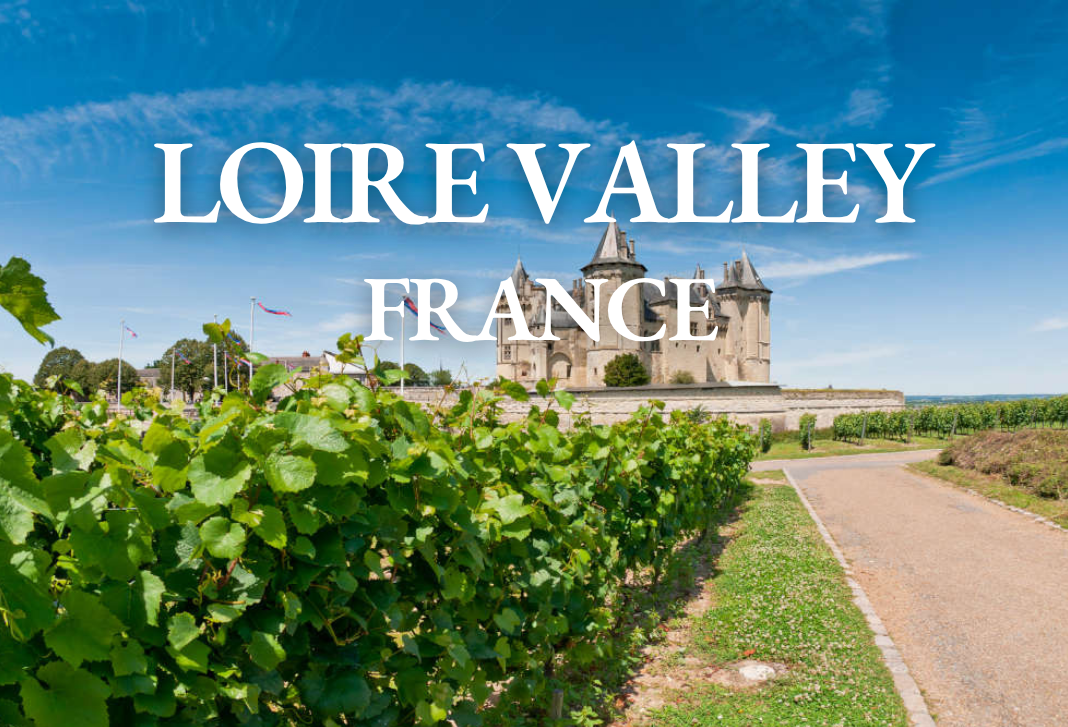
France’s Most Underrated Wine Region
I used to think of the Loire Valley as the place between Paris and Bordeaux—somewhere you drove through on your way to more important wine regions, pausing maybe to see some châteaux but not expecting the wine to be memorable. Then I spent a week drinking Muscadet with oysters in Nantes, Sancerre with goat cheese in the eastern hills, and Chinon with everything in between, and I realized I’d been completely wrong about what matters in wine.
The Loire Valley doesn’t make power wines. It doesn’t make wines that impress critics with ripeness and concentration. It makes wines that disappear from the table before you realize you’ve finished the bottle—wines so drinkable, so perfectly suited to food, so refreshingly honest that they make you question why anyone bothers with the overworked, over-oaked, over-everything wines that dominate so many other regions.
This is France’s longest wine region, stretching 600 miles from the Atlantic coast inland along the Loire River and its tributaries. It’s cool-climate viticulture at its best: high acidity, moderate alcohol, wines that taste like something other than alcohol and fruit. The Loire makes the kind of wine that’s supposed to accompany life rather than interrupt it, which might be why it took me years to appreciate it. I was looking for wines that demanded attention. The Loire makes wines that reward it quietly, over time, with food and friends.
The Geography: Following the River
Understanding the Loire Valley means understanding that it’s not one place but several distinct regions connected by a river. As you move from the Atlantic coast inland, the climate changes, the grapes change, and the wines become completely different. Trying to generalize about “Loire wine” is like trying to generalize about “California wine”—technically possible but not particularly useful.
The Atlantic influence moderates temperatures near the coast, creating cool, maritime conditions perfect for Melon de Bourgogne (the Muscadet grape) and surprising amounts of excellent sparkling wine. As you move inland, the climate becomes more continental—warmer summers, colder winters, more vintage variation. By the time you reach Sancerre in the east, you’re closer to Burgundy than to the ocean, and it shows in the wines.
The Loire’s diversity is its strength and its marketing challenge. There’s no single “Loire style” because the region produces bone-dry whites, off-dry whites, sparkling wines, light reds, serious reds, rosés, and dessert wines. The unifying characteristics—when they exist—are freshness, acidity, and a certain restraint that can read as austerity if you’re expecting California ripeness but as elegance if you’re not.
The Four Main Loire Regions: West to East
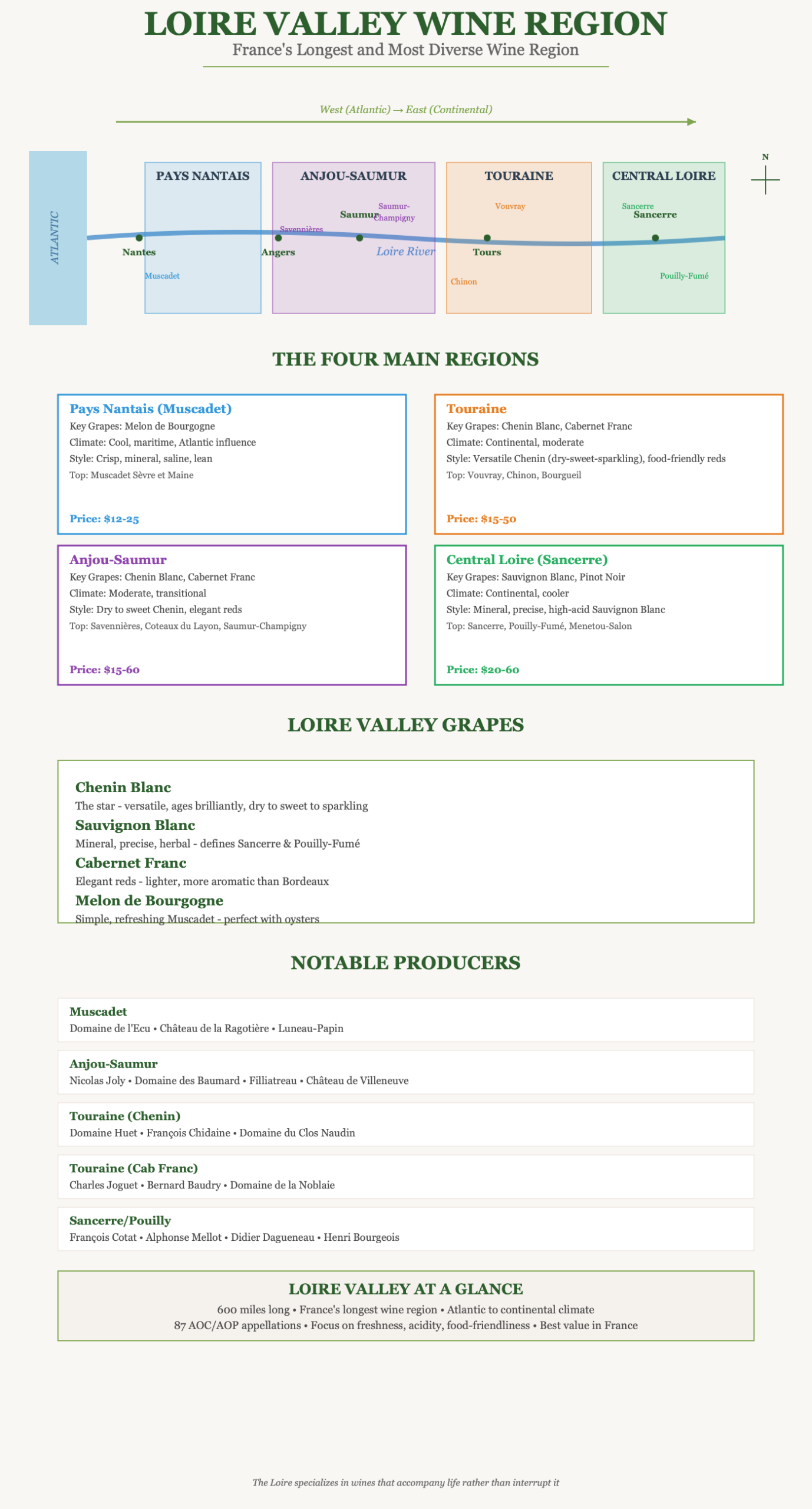
Pays Nantais (Muscadet Country)
This is the western Loire, close to the Atlantic, where Muscadet comes from. Muscadet is one of those wines that people dismiss without trying—it’s inexpensive, it’s simple, it’s not trying to be important. And then you have it with a plateau de fruits de mer, and suddenly it makes perfect sense.
Muscadet is made from Melon de Bourgogne, a grape that was planted here after a catastrophic 1709 winter killed most of the region’s vines. It produces lean, mineral wines with citrus notes and a saline quality that comes from proximity to the ocean. The best Muscadets spend time on their lees (dead yeast cells), which adds texture and complexity to what would otherwise be a very simple wine. Look for “sur lie” on the label.
This is not wine for contemplation. It’s wine for drinking with food—specifically with seafood, oysters, and the kind of simple preparations that Loire cooking does so well. It’s also absurdly affordable ($12-20 for good bottles), which means you can drink it regularly without feeling like you’re either splurging or settling.
Key Appellations: Muscadet Sèvre et Maine (the best), Muscadet Coteaux de la Loire, Muscadet Côtes de Grandlieu
Grape: Melon de Bourgogne
Style: Crisp, mineral, lean, citrus, best with seafood
Price Range: $12-25
Anjou-Saumur (The Middle Loire)
This is where the Loire starts to get interesting in ways that wine people care about. Anjou-Saumur produces a bewildering array of wine styles, from bone-dry Chenin Blanc to sweet Coteaux du Layon, from light Cabernet Franc rosés to serious reds from Saumur-Champigny.
Chenin Blanc is the star here—one of the world’s great grape varieties that deserves far more recognition than it gets. Chenin can be dry, off-dry, sweet, or sparkling, and it ages brilliantly. Dry Chenin from Savennières is mineral-driven, age-worthy, and somewhat austere in youth but develops honey and lanolin notes with time. Sweet Chenin from Coteaux du Layon or Quarts de Chaume can last for decades and represents some of the world’s greatest dessert wines at prices that don’t require a loan.
The reds here are Cabernet Franc-based, lighter than Bordeaux but with more substance than Beaujolais. Saumur-Champigny makes particularly good red wine—earthy, with red fruit and a leafy, herbal quality that works beautifully with food. This is Loire red at its most serious.
Key Appellations: Savennières (dry Chenin), Coteaux du Layon (sweet Chenin), Saumur-Champigny (red), Anjou (rosé and various styles)
Grapes: Chenin Blanc (dominant), Cabernet Franc
Style: Diverse—mineral dry whites, luscious dessert wines, food-friendly reds
Price Range: $15-60 (more for sweet wines)
Touraine (The Heart of the Loire)
Touraine is the central Loire, home to more châteaux per square mile than anywhere else in France and some of the region’s most appealing wines. This is where you find Vouvray (Chenin Blanc in various styles) and Chinon (Cabernet Franc red wine that’s become a darling of the natural wine movement).
Vouvray deserves special attention because it demonstrates what Chenin Blanc can do. Vouvray can be dry (sec), off-dry (demi-sec), sweet (moelleux), or sparkling, and the best examples age for decades. Dry Vouvray in good vintages is one of the world’s great white wines—complex, mineral, with orchard fruit and a waxy texture. Off-dry Vouvray is dangerously drinkable and works with more food than you’d expect. Sparkling Vouvray is an excellent and affordable alternative to Champagne.
Chinon makes red wine from Cabernet Franc that’s lighter and more aromatic than Bordeaux Cabernet but with enough structure to be taken seriously. The best Chinons show cassis, violets, and a distinctive graphite/pencil shaving quality that either appeals to you or doesn’t. Drink it slightly chilled and it’s perfect summer red wine. Age it for 5-10 years and it develops complexity that belies its modest reputation.
Key Appellations: Vouvray (Chenin, all styles), Chinon (Cabernet Franc red), Bourgueil (Cabernet Franc red), Montlouis-sur-Loire (like Vouvray but across the river)
Grapes: Chenin Blanc, Cabernet Franc
Style: Versatile Chenin (dry to sweet to sparkling), elegant Cabernet Franc reds
Price Range: $15-50
Central Loire (Sancerre & Pouilly-Fumé)
This is the Loire that wine people know—Sancerre and Pouilly-Fumé, the appellations that put Sauvignon Blanc on the fine wine map and continue to define what the variety can be when it’s not trying to imitate New Zealand.
Sancerre and Pouilly-Fumé produce Sauvignon Blanc that’s mineral, precise, and restrained—citrus, grass, flint, with high acidity and no tropical fruit in sight. These are wines that taste like they come from somewhere specific, not like they could be from anywhere with a warm climate and stainless steel tanks. The best examples are genuinely age-worthy, developing complexity over 5-10 years that contradicts everything you think you know about Sauvignon Blanc.
The eastern Loire also produces red wine from Pinot Noir (Sancerre Rouge) that’s lighter than Burgundy but can be quite good from serious producers. It’s a niche product, but if you like lighter reds and can find good examples, they’re worth trying.
Key Appellations: Sancerre, Pouilly-Fumé, Menetou-Salon (similar but cheaper), Quincy, Reuilly
Grapes: Sauvignon Blanc (dominant), some Pinot Noir
Style: Mineral, precise, high-acid Sauvignon Blanc; light, elegant Pinot Noir
Price Range: $20-60 (more for top producers)

Credit: Winetourism.com
The Loire Grapes: Fewer Varieties, More Character
The Loire is remarkably focused on just a handful of grapes, which is refreshing in a wine world that often seems to grow everything everywhere. Understanding these grapes is key to understanding the Loire.
- Sauvignon Blanc in the Loire tastes nothing like Sauvignon Blanc from New Zealand or California. It’s mineral, herbal, citrusy, with flinty notes and high acidity. No passion fruit, no cut grass, no aggressive aromatics—just precise, food-friendly wine that shows terroir more than varietal character.
- Chenin Blanc is the Loire’s greatest grape and one of the most versatile varieties in wine. It can be bone-dry, off-dry, sweet, or sparkling. It has high natural acidity that allows it to age for decades. In good hands, Chenin produces wines with honey, quince, lanolin, and mineral notes that develop extraordinary complexity with time. It deserves to be as famous as Chardonnay but remains undervalued.
- Cabernet Franc in the Loire is lighter, more aromatic, and more food-friendly than in Bordeaux. It shows red fruit, violets, herbs, and a distinctive graphite quality. Loire Cab Franc doesn’t try to be powerful—it tries to be elegant and versatile, which it achieves when it’s ripe enough. In cool years, it can be thin and herbal; in good years, it’s delicious and underpriced.
- Melon de Bourgogne (Muscadet) is perhaps the least exciting grape in fine wine, and that’s fine. It makes simple, refreshing wine that costs $15 and pairs perfectly with oysters. Not every grape needs to be profound.
- Pinot Noir appears in the eastern Loire (Sancerre Rouge) and makes light, elegant reds that can be quite good but rarely rival Burgundy. Think of it as a bonus grape rather than a reason to visit the region.
The Loire Producers: Who to Trust
The Loire has moved away from large négociants toward smaller, quality-focused producers—many working organically or biodynamically, many associated with the natural wine movement. This shift has raised quality dramatically but also made the wines somewhat harder to find and occasionally inconsistent.
Muscadet Producers
Domaine de l’Ecu makes biodynamic Muscadet that’s more complex and interesting than you expect from the appellation. Their Expression de Gneiss shows what Muscadet can be when treated seriously—mineral, textured, age-worthy.
Château de la Ragotière produces classic Muscadet sur lie that represents the appellation at its best—crisp, saline, perfect with seafood, and reliably around $15.
Luneau-Papin makes several cuvées that demonstrate different terroirs within Muscadet. Their Excelsior bottling is excellent and shows that Muscadet can age for several years.
Anjou-Saumur Producers
Nicolas Joly (Coulée de Serrant) is the biodynamic pioneer whose Savennières are either brilliant or over-the-top depending on your tolerance for oxidative winemaking and philosophical manifestos. The wines are distinctive, age-worthy, and expensive.
Domaine des Baumard makes benchmark sweet Chenin from Coteaux du Layon and Quarts de Chaume…luscious, balanced, reasonably priced for dessert wine of this quality.
Domaine Filliatreau produces excellent Saumur-Champigny; serious Cabernet Franc that shows what Loire red wine can achieve. Their Vieilles Vignes bottling is particularly good.
Château de Villeneuve makes classic Saumur-Champigny that’s elegant, food-friendly, and fairly priced. This is Loire red that works with dinner rather than overwhelming it.
Touraine Producers
Domaine Huet is the Vouvray benchmark. Biodynamic farming, traditional winemaking, wines that age for decades. Their Le Mont bottling is extraordinary, their Pétillant (sparkling) is excellent, and everything they make demonstrates what Chenin Blanc can be.
François Chidaine makes both Vouvray and Montlouis-sur-Loire with precision and intensity. His wines are mineral-driven, age-worthy, and increasingly sought after.
Charles Joguet (Chinon) set the standard for Loire Cabernet Franc. Single-vineyard bottlings that show terroir differences within Chinon. The wines are elegant, complex, and prove that Loire red deserves serious attention.
Domaine Bernard Baudry makes excellent Chinon across a range of prices. Their Les Granges bottling is accessible and delicious; their single-vineyard wines are more serious and age-worthy.
Sancerre & Pouilly-Fumé Producers
François Cotat makes Sancerre that redefines what the appellation can be…powerful, complex, age-worthy wines from old vines. Expensive, hard to find, and absolutely worth seeking out.
Alphonse Mellot is a large Sancerre producer making consistently excellent wine across their range. Their Generation XIX bottling is serious, age-worthy Sancerre; their basic Sancerre is reliable and well-priced.
Didier Dagueneau (Pouilly-Fumé) was the region’s revolutionary figure before his death in 2008, making Sauvignon Blanc that aged like white Burgundy. His daughter continues the estate, and the wines remain extraordinary and expensive.
Henri Bourgeois makes both Sancerre and Pouilly-Fumé that are consistently good and widely available. Their La Côte des Monts Damnés bottling from Sancerre is excellent.
What to Buy When: A Practical Guide
For everyday drinking with food ($15-25): Muscadet sur lie from any decent producer, basic Sancerre or Touraine Sauvignon Blanc, Chinon or Bourgueil from négociants. These are wines you can open on Tuesday without feeling like you’re either splurging or settling.
For weekend dinners or when you want something special ($25-45): Savennières from a good producer, Vouvray sec from Domaine Huet or François Chidaine, Sancerre from Alphonse Mellot, Chinon from Bernard Baudry. Step up significantly in complexity while maintaining food-friendliness.
For cellaring or special occasions ($50-100+): Coteaux du Layon or Quarts de Chaume (sweet Chenin), aged Vouvray from top producers, Pouilly-Fumé from Dagueneau, single-vineyard Chinon or Sancerre from top producers. These wines will age for decades and show what Loire viticulture can achieve.
For summer drinking: Anything from the Loire, honestly, but especially Muscadet (chilled to near-freezing), Chinon or Bourgueil (served cool), Sancerre or Pouilly-Fumé, sparkling Vouvray. The Loire specializes in wines that work when it’s hot.
For oysters specifically: Muscadet sur lie, period. This is what the wine was made for.
Why the Loire Matters
The Loire Valley is having a moment, particularly among younger wine drinkers and the natural wine community. Part of this is the wines themselves. They’re fresh, moderate in alcohol, food-friendly, and distinctly not trying to impress you with power or ripeness. They taste like they come from somewhere specific rather than like they could come from anywhere.
Part of it is price. Loire wines remain affordable relative to their quality. You can buy excellent Muscadet for $15, serious Chinon for $25, and even prestigious Sancerre for $35-40. Compare that to Napa Cabernet or Burgundy Pinot Noir at similar quality levels, and the Loire looks like a bargain.
Part of it is the natural wine movement, which has embraced the Loire’s lighter, fresher style and organic farming traditions. Whether this is good or bad depends on your tolerance for occasionally funky wines, but it’s undeniably raised the Loire’s profile among certain wine drinkers.
For me, the Loire matters because it makes wine that accompanies life rather than interrupting it. I keep Muscadet in my fridge for weeknight oysters or fish, Chinon for casual dinners, and a few bottles of good Vouvray for when I want something that rewards attention without demanding it. These aren’t wines that make you stop and think “wow, this is amazing wine.” They’re wines that make you stop and think “wow, this is a really good dinner,” which might actually be more valuable.
The next time you’re in a wine shop looking for white wine that isn’t Chardonnay or Sauvignon Blanc from the usual places, grab a bottle of Vouvray or Savennières. When you want red wine that won’t overpower your food, try Chinon or Saumur-Champigny. When you’re serving oysters, buy Muscadet and don’t apologize for it.
The Loire Valley doesn’t make the most impressive wines in France. It makes some of the most useful ones, which in the context of actual wine drinking might be more important. That’s not a criticism—it’s the highest compliment I can give.



Leave A Comment