
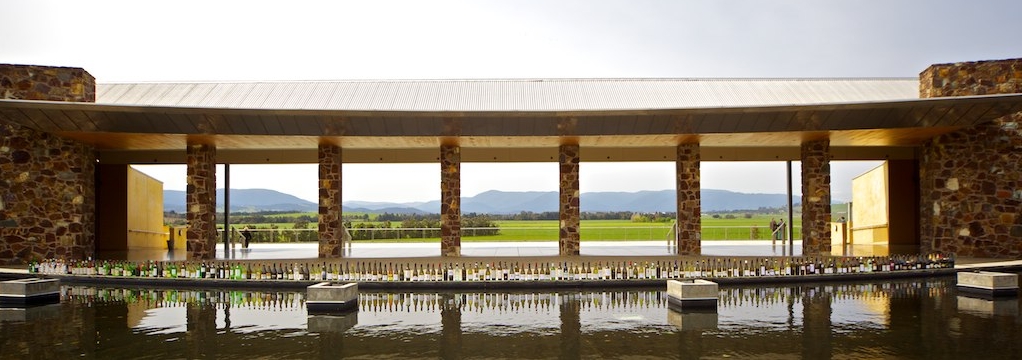
The Landmark Tutorial: Sparkling Wines presented by Ed Carr and Dr. Tony Jordan
Sparkling wine in Australia has gone through a quality revolution in recent memory. As Ed Carr and Tony Jordan elaborated, prior to the early 1970s, most sparkling wines in Australia were made via tank method and labelled ‘Champagne’. With a growing export market – and, of course, pressure from the European Union and Champagne industry – Australian sparklers had to re-define themselves in all senses. Here are the sparklers sampled at the Landmark Tutorial: Sparkling Wines event.
- NV Brown Brothers Brut Chardonnay/Pinot Noir/Pinot Meunier, King Valley
- NV House of Arras Brut Elite Cuvee 401 Pinot Noir/Chardonnay, Tasmania
- 2005 Domaine Chandon ZD Blanc de Blancs Chardonnay, Victoria
- 2001 House of Arras Blanc de Blancs Chardonnay, Tasmania
- 2006 Coldstream Hills Yarra Valley Chardonnay/Pinot Noir, Yarra Valley
- 2005 Yering Station Yarrabank Chardonnay/Pinot Noir, Yarra Valley
- 2005 Domaine Chandon Yarra Valley Brut Pinot Noir/Chardonnay
- 2005 Brown Brothers Patricia Brut Pinot Noir/Chardonnay, King Valley
- 2003 House of Arras Grand Vintage Chardonnay/Pinot Noir, Tasmania
- 2002 Domaine Chandon Prestige Cuvee Chardonnay/Pinot Noir, Victoria & Tasmania
- 2000 Freycinet Radenti Chardonnay/Pinot Noir, Tasmania
- 1999 House of Arras EJ Carr Late Disgorged Chardonnay /Pinot Noir, Tasmania
- 1998 Stefano Lubiana Vintage Brut Pinot Noir/Chardonnay, Tasmania
- 2006 Domaine Chandon Vintage Brut Rosé, Victoria & Tasmania
- 2003 Kreglinger Brut Rosé, Tasmania
During this session, Carr explained how, even in Australia’s coolest zones, viticulture is not a question of ‘running out of season’ as is so often the case in Champagne, a highly marginal climate. Time of picking is, therefore, critical for achieving a degree of ripeness ‘but not at too high Baumé’ (i.e. not at too high a must weight).
Viticultural innovations have meant that the current base wines used for classic Australian sparkling wines are higher in quality than ever before, although debate remains, in the ‘fault-sensitive’ echelons of the Aussie winemaking industry, as to whether those base wines should be treated oxidatively in old oak – which can lead to funky savoury aromas, as in the 2005 Brown Brothers Patricia Brut Pinot Noir/Chardonnay – or strictly without oxidation in stainless steel, which typically gives purity of fruit.
One sad omission, commented on in the seminar by Fongyee Walker, was the lack of a sparkling red, not least one of Australia’s Sparkling Shirazes (perhaps the Mount Langi Ghiran Cliff Edge Sparkling Shiraz would have worked here). But Carr did provide an update on just how much improved sparkling red production is; formerly a dumping ground for excess juice from bulk black grape varietals. For example, special enzymes are now used in sparkling red winemaking to aid colour extraction without conferring too much tannin to base wines (overt tannin being hardly desirable in red sparklers).
The stand-out wines for me from this session were: 2001 House of Arras Blanc de Blancs Chardonnay, 2003 House of Arras Grand Vintage Chardonnay Pinot Noir, 1999 House of Arras EJ Carr Late Disgorged Chardonnay Pinot Noir and 1998 Stefano Lubiana Vintage Brut Pinot Noir Chardonnay, all seriously complex sparkling wines by any standards.
~Edward Ragg
Editor’s note: This is an ongoing 13-part series of Edward Ragg’s account of Australia’s Landmark Tutorial. Each week, Edward will give us an insider’s view of the program. Join us next week as he covers a blind tasting of Shiraz with Tim Kirk.



This is a good, common sense article. Very helpful to one who is just finding the resouces. It will certainly help educate me.
thanks !! very helpful post!