I have a bottle of 2021 Barolo sitting in my closet that I bought three years ago. Every few months, I think about opening it. Then I remember what the wine merchant told me when I bought it: “Give it at least ten years.” Ten years. A decade of occasionally moving this bottle from one condo to another, of resisting the urge to crack it open on a random Tuesday, of hoping that whatever mysterious alchemy happens inside that glass will be worth the wait.
This is the central tension of age-worthy wine: you’re betting on future pleasure against present temptation. And unlike most gambles, you can’t really know if you’ve won until it’s too late to change course.
The thing is, most wine isn’t meant to age at all. Experts estimate that only 5-10% of wine improves after one year, and only 1% improves after 5-10 years. Which means that beautiful bottle you’ve been saving for a special occasion? There’s a decent chance it peaked two years ago and has been slowly declining ever since.
But that 1%—those wines built for the long haul—they’re genuinely different. Not better, necessarily, but different in ways that matter if you care about complexity, evolution, and the kind of wine that makes you put your glass down and just think for a minute.
The Four Pillars of Age-Worthiness
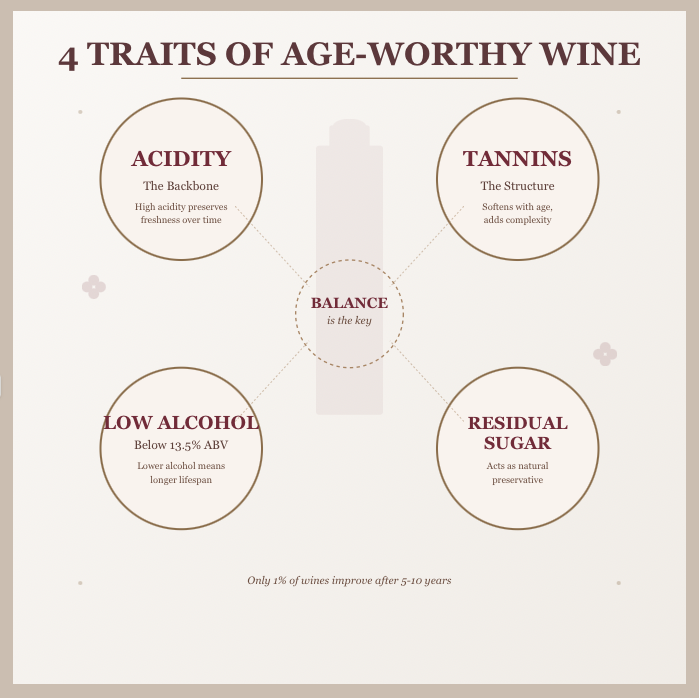
Wine professionals use a kind of deductive reasoning when they taste a young wine and try to predict its future. It’s part science, part experience, part educated guess. But there are four characteristics that most wine people agree on: high acidity, tannin structure, low alcohol level, and residual sugar.
These aren’t arbitrary. Each one acts as a kind of natural preservative, giving the wine runway to evolve rather than simply deteriorate.
1. Acidity: The Backbone That Never Quits
Wines with higher acidity tend to last longer because as wine ages it slowly loses its acids and flattens out. Think of acidity as the spine that holds everything else upright. Without it, wine becomes flabby and dull…the liquid equivalent of a deflated balloon.
This is why Riesling, with its razor-sharp acidity, can age for decades. Some of the best Riesling can age for 100 years or more. A twenty-year-old German Riesling doesn’t taste like lemon juice anymore. The acidity has mellowed—but it still has enough structure to keep the wine vibrant and alive.
The same principle applies to red wines. Wines with a low pH—like Pinot Noir and Sangiovese, have greater capability for aging. Lower pH means higher acidity, which means more runway.
When you’re evaluating a wine for aging potential, pay attention to the finish. Wines usually have a long tingly aftertaste from the acidity paired with residual fruit flavors. If you feel just the dry astringency of tannin, the wine might be out of balance. Balance matters as much as raw acidity—a wine that’s all acid and no fruit won’t magically become harmonious with age.
2. Tannins: The Rough Edges That Smooth Out
Tannins are those compounds that make your mouth feel dry and slightly puckered, like you’ve been chewing on a tea bag. They come from grape skins, seeds, and stems during winemaking, and from oak barrels during aging. Tannins act as preservatives and over time, they soften and polymerize, adding structure and complexity.
This is why young Barolo or Bordeaux can taste almost unpleasantly astringent—your teeth might literally stick to your lips. But give those wines a decade or two, and the tannins break down into something rounder, softer, more integrated. The wine that once felt like an assault becomes layered and nuanced.
Wines with moderate tannin from both oak and grape have a longer runway to age. Note: moderate. Too much tannin without corresponding fruit and acidity just means you’ll have a wine that’s still harsh after ten years, just with faded fruit. Not an improvement.
White wines generally lack tannins, which is why most whites aren’t built for long aging. But there are exceptions: whites aged in oak barrels pick up some tannin from the wood, and orange wines, made with extended skin contact, develop enough phenolic structure to age surprisingly well.
3. Alcohol: Less Is Paradoxically More
Here’s where it gets counterintuitive. Alcohol is volatile in non-fortified wines and causes wine to turn to vinegar more quickly. Generally speaking, the lower the alcohol level in a non-fortified wine, the longer it will last.
When evaluating age-worthy wine, look for ABV below 13.5%. Higher alcohol can make wines feel hot and unbalanced, and that heat doesn’t mellow with age. It just becomes more pronounced as the fruit fades.
The exception, of course, is fortified wines like Port, Madeira, Sherry. These wines have added spirits that push alcohol levels to 17-20%, and they can age for literal centuries. But that’s because fortification is itself a preservation technique, deliberately using alcohol to stop fermentation and protect the wine.
For regular still wines, though? Lower is better. This is part of why cool-climate wines often age better than warm-climate versions of the same grape…cooler temperatures mean slower ripening, which means more acidity and lower alcohol at harvest.
4. Residual Sugar: The Secret Weapon
Sugars have been used as a fruit preservative (jam) for a very long time, so it makes sense that sweet wines can age incredibly well. Sauternes ages well because it combines high acidity with high sugar levels, creating a wine that can last 40+ years or more.
The key is that the sugar needs to be balanced by acidity. A wine that’s sweet but low in acid will just taste cloying and heavy over time. But wines like Tokaji, Sauternes, or Spätlese Riesling combine both elements; enough sugar to act as a preservative, enough acid to keep everything fresh.
Interestingly, when you taste a sweet wine to check for its cellar-worthiness, you’ll be surprised how dry it tastes for the level of residual sugar. A good Spätlese Riesling will have around 90 g/L residual sugar and taste only off-dry, with ripping high acidity and a touch of bitterness on the back mid-palate.
What Actually Happens During Aging
I used to imagine wine aging like getting better at something with practice; each year making it more refined, more perfect. But it’s not really like that. Wine aging is more like watching someone grow older: they become different, not necessarily better. Less exuberant, more contemplative. The energy of youth replaced by something subtler and more complex.
As red wine ages, harsh tannins gradually give way to a softer mouthfeel. An inky dark color will eventually lose its depth and begin to appear orange at the edges, and eventually turn brown. Primary fruit flavors fade and are replaced by what wine people call “tertiary” characteristics—leather, tobacco, dried fruit, forest floor, truffle.
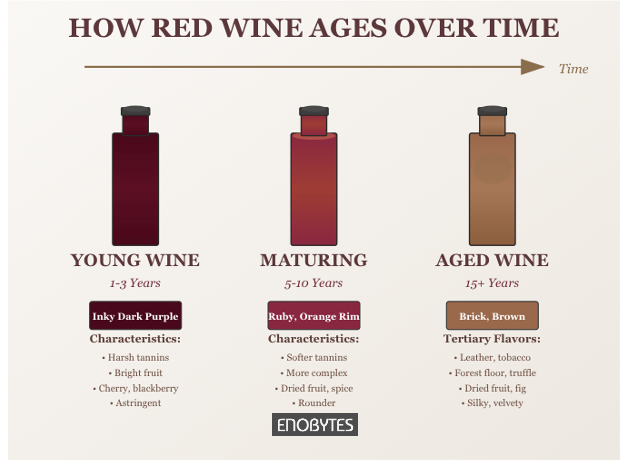
Left Glass – Young Wine (1-3 years):
- Deep inky purple/dark color
- Harsh tannins
- Bright fruit flavors (cherry, blackberry)
- Astringent mouthfeel
Center Glass – Maturing Wine (5-10 years):
- Ruby red with visible orange rim developing
- Softer tannins
- Developing complexity with dried fruit and spice
- Rounder mouthfeel
Right Glass – Aged Wine (15+ years):
- Brick/brown color throughout
- Tertiary flavors: leather, tobacco, forest floor, truffle
- Dried fruit and fig notes
- Silky, velvety texture
Some wines go through what Bordeaux producers call the “age ingrat” or difficult age—a dumb phase where the wine closes up and doesn’t show much of anything. You open a bottle expecting evolution and get… not much. Then a year or two later, the same wine emerges transformed. The cause or length of time that this dumb phase will last is not yet fully understood and seems to vary from bottle to bottle.
This unpredictability is part of why aged wine is both exciting and frustrating. You’re dealing with a living thing that doesn’t follow a predictable script.
Not Every Great Wine Needs to Age
Here’s what took me years to accept: not every great wine needs to be cellared for years. Some of the most delicious wines I’ve had were meant to be drunk young—Beaujolais, fresh Riesling, unoaked Chardonnay, most rosé. These wines are built around immediate pleasure, not delayed gratification.
There is a widespread misconception that wine always improves with age, or that aging potential is an indicator of good wine. Some authorities even argue that more wine is consumed too old than too young. Fruitiness deteriorates rapidly, decreasing markedly after only six months in the bottle.
The question isn’t “should I age this wine?” but “what kind of wine experience am I looking for?” If you want exuberant fruit and freshness, drink it young. If you want complexity and evolution, age it, but only if the wine has the structure to support that journey.
The Test You Can Do at Home
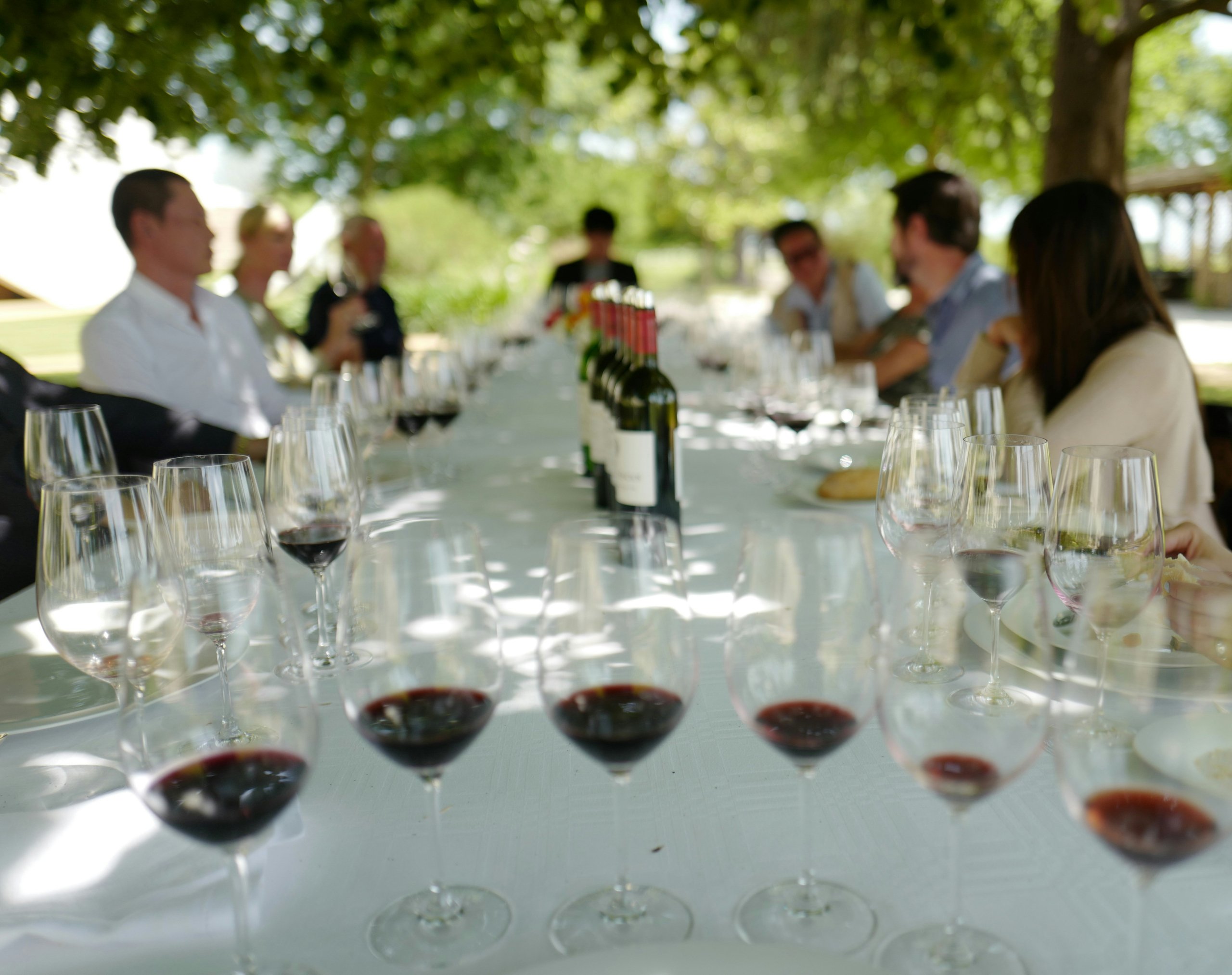
Some collectors use the “second-day test” to determine a wine’s aging potential. Open the bottle, pour a generous glass, and immediately put the cork back on—don’t use pumps or preservatives. Taste the wine and make notes. A couple of hours later, pour another glass and taste again. Put the cork back on and leave it on the counter overnight. Taste again the next day. Most wines will have faded, but if yours still tastes good—or better (good sign)—then you can generally expect it to age well for many years.
The logic is simple: if a wine can’t handle 24 hours of air exposure, it won’t handle years in a bottle. Age-worthy wines are built tough.
What I Keep Coming Back To
That Barolo in my closet is now four years old. I’ve got another six years to go by the wine merchants estimate, assuming she’s right. Maybe it’ll be transcendent. Maybe it’ll be good but not worth-the-wait good. Maybe I’ll open it and discover I’ve waited too long, that the window of peak drinking has already closed.
The uncertainty is part of the appeal, I think. In a world where everything is instant and optimized and algorithmic, cellaring wine is an act of faith. You’re betting that patience will be rewarded, that some things genuinely are better when you wait for them.
And when it works—when you open a twenty-year-old wine and taste layers of complexity that weren’t there a decade ago, when the wine tells a story about time and transformation, it feels like proof that not everything worth having can be had immediately.
The four traits are your starting point: acidity, tannin, lower alcohol, residual sugar. But what really makes a wine age-worthy is balance. Age-worthy wines feel complete, even when young. They may be tight, but they’re not awkward. If a wine feels unbalanced now, cellaring probably won’t fix it.
So look for wines with structure. Pay attention to the finish. Trust producers with a track record of making wines that improve with time. And then—the hardest part—wait. Or don’t wait. There’s no wrong answer, really. Just different kinds of pleasure at different moments.
Though I’ll tell you this: when I finally open that Barolo, I’m inviting people over. Because if you’re going to wait a decade for something, you might as well share it with people who’ll appreciate the fact that you did.