
Cement Egg Fermentors
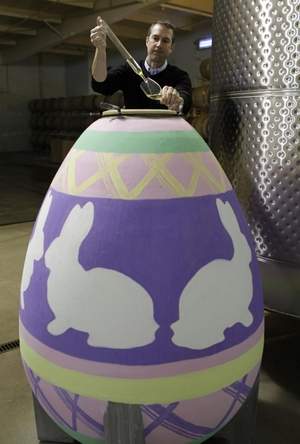
Cement Egg Fermentors: This might seem like something of an oddity, but what you see in the picture is an egg-shaped Domain Carneros cement ferment vessel dressed up as an Easter egg. It caught my eye from a recent press release and since I recently tasted their Blanc de Blancs Le Rêve and enjoyed it immensely, I was excited to try their Pinot noir fermented from a cement vessel. Sure, it makes for an awesome little Easter story, but even more so, I thought it would be interesting to compare and contract what this wine offers compared to fermenting from other vessels like oak and stainless steel.
Cement vessels are certainly not new. Heck, the Romans were using them some 2,000 years ago, and many of the world’s finest wineries still use them. But why would a winemaker use concrete, especially a vessel shaped like an egg? In geek talk, they offer excellent thermal inertia, as well as controlled micro-oxidation, and are flavor neutral and durable. In winemaker’s terms, it is like killing three birds with one stone.
In simple terms, thermal inertia is the degree of which the winemaker controls temperatures during the fermentation process—if the fermentation heats up too quickly, you’ll end up with cooked wine, and no one likes stewed fruit. Concrete allows the winemaker to slow down the process and lower the temperatures during fermentation.
As for micro-oxidation, this is a process used to introduce oxygen into wine in a controlled manner and there needs to be a balance—too much oxygen leads to oxidation and too little leads to reduction and the ensuing wine faults. And as for the neutrality of concrete, it imparts no flavors of its own, allowing the flavors of the wine to shine through and express more fruit expression. Seems reasonable, no?
Now you have probably seen or heard of these vessels in the past. Recall a story I wrote a while back about Château Cheval Blanc, one of the great-classified growths of Bordeaux. They recently finished a new cutting-edge winery, where they installed fifty-two modular style cement tanks (see photos 4 & 7). And if you have ventured to Burgundy, you have probably seen them first hand. Many of the California producers use them as well, including Domain Carneros, which purchased the egg style tanks from Nomblot’s, a company that has been around since 1922, designing an array of round, oval, conical, and even vertical and horizontal elliptical and egg shaped vessels in a range of fermentation, aging and storage tanks for clients such as Domain Carneros, Domaine de la Romanee and Lafite-Rothschild.
Winemaker TJ Evans at Domain Carneros credits their egg’s concrete walls and round “feng-shui” shape (pictured above) with enhancing minerality and rounding flavors, which results in richer, more layered wines compared to other ferment vessels. So when sampling the wine, did I pick up this round, rich, layered flavor profile? Well, it is definitely a Burgundian style wine, elegant and refined, smooth and silky. It is delicious, displaying raspberry and black cherry, finishing smoky and toasty, with good balance and acidity—perfect characteristics to make it a great food friendly wine to match up with diverse culinary applications—hazelnut crusted salmon with mustard vinaigrette, mushroom quiche, or a roasted leg of lamb with mint pesto. Am I making you hungry? Overall, what makes this wine special is the delicate, round layers that really come out with the right food pairing.
But can we attribute these round layers to the egg ferment vessel, or could another vessel serve the same purpose? …or do we attribute it to something else like great fruit, winemaker techniques, superstar winemakers, or….?
Egg fermentors—are they all what they are cracked up to be?
Maybe this would make a good experiment. What if we get a group together to blind taste wines—cement versus XYZ (e.g. oak, stainless steel, etc) and do a side-by-side comparison?
[twitter_follow username=”enobytes” language=”en”]
Photo credit: Eric Risberg. Eileen Crane, left, founding winemaker and president and TJ Evans, right, Pinot Noir winemaker, talk about their concrete egg fermenter at the Domaine Carneros winery in Napa, Calif.








Funny picture :) Actually, Oregon producer Archery Summit is using one (though their’s isn’t decorated). It would be interesting to hear their perspective.
I’ll reach out to them! I think it would be great to hear their perspective, thanks Tamara!
I saw loads of them in Argentina. Laurent Montalieu also uses them.
Good to know, thanks Lisa!
Based on all of the twitter conversation on this subject I suggest we do a meetup to compare and contrast cement vs other vessels! Who is in? Portland, Las Vegas and San Francisco are possible locations to host the event.
How about Walla Walla? We use one for the Walla Faces 2010 Riesling “Verlynn”. Would love to do side by side tasting!
That would be a great comparison! We’ll have to see how we coordinate the get together…
Would be happy to help coordinate/arrange on this end!
Will you be at the wine bloggers conference in Portland this year? Maybe it would be fun to do a comparison tasting then!?!
We use concrete tanks (not egg shaped), and oak tanks for roughly three quarters of all fermentations. And we use concrete eggs for red wine aging as well. This year we will ferment our Sav blanc in the egg.
From the many tastings I’ve been to with other winemakers, the concrete wines are rarely bottled as is. They are almost always blended with some barrel or tank aged wines. While the concrete can bring out some unique characateristics, the wines are rarely bottled as is. And Im afraid most winemakers will not tell you exactly how they blend. And some may be even more reluctant to taste straight from the egg (or concrete). That’s just been my experience here in Napa.
Its sort of like restaurant chefs not sharing their secret recipe — they sort of give you the basics of how to make a dish but intentionally forget to mention that special step that makes the dish. It drives every wanna be chef go bonkers when they cant replicate it to taste like the original dish. But who can blame them? Every pro learns along the way and finds a uniqueness in style that makes a dish shine. Same with wine making. Blending is an art. But it would be awesome to taste something directly from concrete compared to something that went through a blending regimen as to compare and contrast…Thanks for chiming in Jack.
Grgich Hills uses them, too. I saw at least one there a while back.
Good to know, thanks Sondra.
I *TOTALLY* volunteer to do the comparative tasting- let me know when/where and I’ll be there! I’ve been really enjoying some of Andy Ericsons stuff from eggs- Ovid especially…
Awesome! Are you scheduling any trips to PDX Josh?
Thanks, I’ve recently been looking for information about this subject for a long time and yours is the best I’ve discovered so far. But, what is the concerning conclusion?