America’s Premier Wine Region
Napa Valley has spent the past fifty years transforming itself from a sleepy agricultural region into America’s most famous, and most expensive wine-producing area. The valley runs roughly thirty miles north from San Pablo Bay to Calistoga, never more than five miles wide, and contains some of the most valuable agricultural land in America. That a place smaller than many American cities has managed to establish itself as the domestic equivalent of Bordeaux says something about American marketing prowess, genuine viticultural potential, and our willingness to pay staggering prices for wine we’ve convinced ourselves is worth it.
Napa contains sixteen sub-appellations, or AVAs (American Viticultural Areas), each claiming distinct characteristics that justify distinct prices. Understanding the basic geography and what grows where remains useful for anyone attempting to navigate Napa’s offerings.
The Lay of the Land
Napa Valley’s geography is surprisingly complex for such a small area. The southern end near San Pablo Bay is cool and foggy, influenced by marine air that moderates temperatures. The northern end near Calistoga is significantly warmer, almost hot, creating conditions more suitable for fuller-bodied wines. The valley floor is relatively flat and planted extensively with vines. The hillsides—Mayacamas range to the west, Vaca range to the east—provide different exposures, drainage, and temperature patterns.
This variation matters. A Cabernet from cool Carneros tastes nothing like one from hot Calistoga, which tastes different from hillside Cabernet grown at elevation. Whether these differences justify the price premiums attached to them is a separate question, but the differences themselves are real.
The soil varies considerably—volcanic, sedimentary, alluvial…though whether the average drinker can taste the difference between volcanic and sedimentary soil in a blind tasting is debatable. Winemakers certainly believe they can, and they’ve convinced enough consumers to believe it too that soil composition now features prominently in tasting room presentations.
Napa’s Sub-AVAs: A Guided Tour from South to North
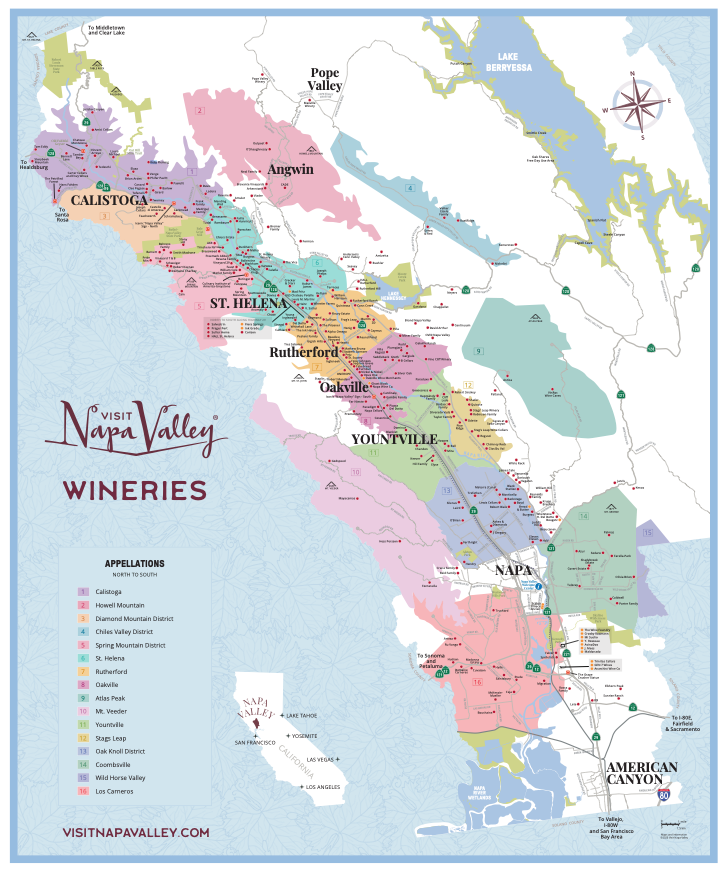
Carneros
Character: Cool, windy, influenced by San Pablo Bay fog
Primary Varietals: Chardonnay, Pinot Noir, some sparkling wine
What to Know: Carneros straddles the Napa-Sonoma border and is one of the few Napa regions where Pinot Noir consistently succeeds. The cool climate creates wines with higher acidity and less alcohol than the valley floor Cabernets that dominate Napa’s reputation. This is where serious producers make Chardonnay that doesn’t taste like butter and vanilla, and Pinot Noir that shows restraint.
Notable Producers: Domaine Carneros (sparkling), Hyde de Villaine, Saintsbury, Bouchaine
Oak Knoll District
Character: Moderate temperatures, afternoon fog from the bay
Primary Varietals: Chardonnay, Merlot, Cabernet Sauvignon
What to Know: Oak Knoll occupies the valley floor north of Carneros and remains cooler than points further north. This is middle ground—warm enough for Cabernet but cool enough that it doesn’t become overripe fruit bombs. The wines tend toward elegance rather than power, which means they’re often more affordable and more drinkable young.
Notable Producers: Trefethen, Robert Biale (Zinfandel), Miner Family
Yountville
Character: Protected from afternoon winds, moderate temperatures
Primary Varietals: Cabernet Sauvignon, Merlot, Sauvignon Blanc
What to Know: Yountville has become as famous for its restaurants (French Laundry, Bouchon) as its wines. The wines themselves tend toward the polished and expensive, though this has as much to do with real estate values as terroir. The appellation is small, and much of what’s grown here ends up in high-end blends rather than single-AVA bottlings.
Notable Producers: Dominus, Cliff Lede, Kapcsandy
Stags Leap District
Character: Eastern hillsides, afternoon shade, alluvial soils
Primary Varietals: Cabernet Sauvignon
What to Know: Stags Leap achieved fame when Stag’s Leap Wine Cellars won the Judgment of Paris in 1976, beating French wines and establishing that California could produce serious Cabernet. The wines from this district tend toward elegance and structure rather than raw power—or at least that’s the story. In practice, many are quite powerful, but the tannins tend to be finer than in some other regions.
Notable Producers: Stag’s Leap Wine Cellars, Shafer, Clos du Val, Chimney Rock
Oakville
Character: Valley floor, gravelly soils, warm but not hot
Primary Varietals: Cabernet Sauvignon
What to Know: Oakville is Napa royalty—home to some of the most expensive vineyards and most prestigious producers. The “Oakville dust” that locals reference is real—a particular tannin structure and earthy quality that appears in the wines. Whether this is worth the premiums charged is a question of means and priorities, but Oakville Cabernet represents Napa at its most polished and expensive.
Notable Producers: Screaming Eagle, Harlan Estate, Opus One, Far Niente, Dalla Valle
Rutherford
Character: Valley floor, famous “Rutherford dust,” warm growing season
Primary Varietals: Cabernet Sauvignon
What to Know: Rutherford sits immediately north of Oakville and makes similar claims to greatness. The “Rutherford dust”—a dusty, earthy quality in the wine—is the appellation’s calling card. Whether this represents terroir or marketing has been debated, but the wines are undeniably distinctive and often excellent. Also undeniably expensive.
Notable Producers: Caymus, Inglenook, Beaulieu Vineyard (Georges de Latour), Staglin, Frog’s Leap
St. Helena
Character: Warmer than southern valley, valley floor and hillsides
Primary Varietals: Cabernet Sauvignon, some Zinfandel
What to Know: St. Helena is a working town that happens to be surrounded by vineyards worth more per acre than most Manhattan apartments. The wines are fuller-bodied than those from cooler southern appellations, with ripe fruit and substantial tannins. This is also where some of Napa’s old Zinfandel survives, providing an alternative to the Cabernet monoculture.
Notable Producers: Grace Family, Spottswoode, Duckhorn, Ehlers Estate
Calistoga
Character: Hot, northern end of valley, volcanic soils
Primary Varietals: Cabernet Sauvignon, Zinfandel, Petite Sirah
What to Know: Calistoga is the warmest part of Napa Valley, which makes it suitable for varieties that want heat. The wines tend to be big, ripe, and powerful—this is not the place for restraint. Zinfandel and Petite Sirah thrive here in ways they don’t in cooler regions. Cabernet gets very ripe, very concentrated, and very expensive.
Notable Producers: Chateau Montelena, Araujo, Lail, Diamond Creek
Spring Mountain District
Character: Western hillsides of Mayacamas range, elevation 400-2,600 feet
Primary Varietals: Cabernet Sauvignon
What to Know: Spring Mountain is Napa’s vertical territory, with vineyards planted on steep hillsides at varying elevations. The wines tend to be structured, age-worthy, and less overtly fruity than valley floor Cabernets. Hillside viticulture is expensive…hand harvesting, lower yields, erosion control, which translates to expensive wine.
Notable Producers: Pride Mountain, Spring Mountain Vineyard, Cain Vineyard
Diamond Mountain District
Character: Eastern slopes of Mayacamas, volcanic soils, elevation 400-2,200 feet
Primary Varietals: Cabernet Sauvignon
What to Know: Diamond Mountain produces Cabernets with volcanic intensity, literally, given the soils and mountain austerity. These are structured wines that require aging and patience, which is either a selling point or an inconvenience depending on your cellar situation and your willingness to wait.
Notable Producers: Diamond Creek, Schramsberg, Von Strasser
Howell Mountain
Character: Eastern mountains, high elevation (1,400-2,200 feet), above fog line
Primary Varietals: Cabernet Sauvignon, Zinfandel
What to Know: Howell Mountain is Napa’s high country, where elevation moderates the heat and creates conditions for wines with both ripeness and structure. The Cabernets are powerful but not blowsy, with firm tannins and capacity for aging. This is also prime Zinfandel territory, producing wines with concentration and complexity.
Notable Producers: Dunn Vineyards, La Jota, Ladera
Mount Veeder
Character: Eastern Mayacamas range, steep slopes, elevation 500-2,000 feet
Primary Varietals: Cabernet Sauvignon
What to Know: Mount Veeder’s wines tend toward the intense and structured mountain wines with grip and power. The elevation and exposure create slow ripening and wines that can be austere in youth. Whether this is a feature or a bug depends on your patience and your preference for wines that demand aging.
Notable Producers: Mount Veeder Winery, Hess Collection, Mayacamas
Atlas Peak
Character: Vaca range, high elevation, volcanic soils
Primary Varietals: Cabernet Sauvignon, Sangiovese
What to Know: Atlas Peak is Napa’s eastern heights, remote and distinct from the valley floor. The wines are structured and mineral-driven, though “mineral” is one of those wine terms that means whatever the speaker wants it to mean. Sangiovese does well here, which is unusual for Napa and gives the appellation a point of differentiation.
Notable Producers: Antinori (Antica), Elan, Paloma
Chiles Valley
Character: Eastern side valley, warmer than main valley, elevation 600-1,200 feet
Primary Varietals: Cabernet Sauvignon, Zinfandel, Sauvignon Blanc
What to Know: Chiles Valley is Napa’s forgotten region…literally a side valley that most visitors never see. This isolation has kept prices somewhat more reasonable, though “reasonable” is relative in Napa. The wines can be excellent, particularly Zinfandel from old vines.
Notable Producers: Volker Eisele, Brown Estate, Green & Red
Wild Horse Valley
Character: Southeastern corner, high elevation, cool and windy
Primary Varietals: Pinot Noir, Chardonnay
What to Know: Wild Horse Valley is Napa’s other cool-climate region, tiny and rarely seen. The wines are closer in style to Carneros than to the valley floor Cabernets. This is specialty territory worth knowing about but unlikely to dominate anyone’s Napa experience.
Notable Producers: Limited production; mostly used for blending
Coombsville
Character: Southeastern valley, protected from wind, moderate temperatures
Primary Varietals: Cabernet Sauvignon, Merlot
What to Know: Coombsville is Napa’s newest AVA (established 2011), which tells you something about the ongoing process of dividing Napa into ever-smaller marketing units. The wines show restraint and elegance. In practice, they’re Cabernets from a region that’s less famous than Oakville or Rutherford, which means they’re sometimes less expensive.
Notable Producers: Ancien, Meteor, Italics
What Grapes Grow in Napa?
Napa’s reputation rests on Cabernet Sauvignon, which occupies roughly half the planted acreage. This monoculture is both strength and weakness. It’s what Napa does best, but it’s also limited the region’s diversity and made certain assumptions about what “Napa wine” means.
Cabernet Sauvignon dominates because it thrives here and because it commands the highest prices. Napa Cabernet at its best shows ripe black fruit, firm tannins, and the structure to age for decades.
Merlot has struggled to find respect in Napa post-Sideways, though good Merlot still emerges from places like Oakville and Rutherford. The variety is often used for blending, adding suppleness to Cabernet-based wines but is an amazing wine on its own.
Chardonnay is Napa’s second most important variety, though it’s mostly planted in cooler regions like Carneros. Napa Chardonnay has moved away from the heavily oaked, buttery style that dominated in the 1990s toward more restrained, mineral-driven wines.
Pinot Noir succeeds in Carneros and a few other cool sites but remains a minor player. Those seeking serious California Pinot generally look to Sonoma or further north.
Sauvignon Blanc appears throughout Napa, often labeled as Fumé Blanc following Robert Mondavi’s terminology. Styles range from crisp and grassy to oak-aged and full-bodied. The variety deserves more attention than it receives.
Zinfandel survives in pockets, particularly in Calistoga and Howell Mountain, though it’s been largely displaced by more profitable Cabernet. Old-vine Zinfandel from these sites can be excellent and offers an alternative to Cabernet’s dominance.
Other varieties—Petite Sirah, Syrah, Sangiovese, Cabernet Franc—appear occasionally and sometimes excel, but Napa’s identity is so bound to Cabernet that alternatives struggle for recognition.
The Economics of Napa
Understanding Napa requires understanding its economics. Vineyard land in prime areas like Oakville or Rutherford can exceed $500,000 per acre. At these prices, growing anything but Cabernet Sauvignon becomes financially questionable. This creates pressure to charge premium prices, which requires premium scores, which encourages winemaking styles designed to impress critics rather than accompany dinner.
The result is a region where $100 bottles are common, $200 bottles are unremarkable, and cult wines can reach four figures. Whether the wines justify these prices is subjective; whether the prices reflect land costs, production expenses, and market demand is not. Napa has become expensive because enough buyers exist who’ll pay these prices, and because the region’s reputation supports premium pricing.
For consumers, this creates challenges. Finding value in Napa requires effort. Looking beyond famous appellations, considering second labels, exploring varieties other than Cabernet. The wines exist, but they’re increasingly rare as land values push everything toward high-end production.
Visiting Napa: A Practical Guide
Napa Valley tourism has evolved from agricultural visits to luxury experiences complete with art collections, gourmet food pairings, and reservation fees that rival the wine prices. Many prestigious wineries require appointments and charge tasting fees of $50-150. Whether this represents necessary crowd control or profit center depends on your perspective, but it’s the reality.
For visitors interested in actually understanding Napa rather than simply collecting tasting room experiences:
Focus on regions rather than trying to see everything. Choose Carneros for cool-climate wines, Rutherford for classic valley-floor Cabernet, Howell Mountain for mountain wines. Attempting to visit six appellations in a day ensures you’ll remember none of them.
Book appointments at smaller producers. The famous names are expensive—lesser-known producers often offer better values and potentially offer more time for conversations.
Visit during off-season (January-March) if possible. Summer and fall harvest are crowded and expensive. Winter is rainy but quieter and sometimes more revealing.
Rent a driver or use car services. Tasting and driving don’t mix, and Napa takes DUIs seriously. The expense of a driver is minor compared to the alternative.
The Top Napa Wine Producers: A Selective List Plus Driving Guide
Ranking Napa producers invites argument, but certain names consistently deliver wines worth seeking out, assuming you can afford them and find them.
Screaming Eagle (Oakville): Cult wine at cult prices. The quality is legitimate; whether it’s worth $3,000+ per bottle is a philosophical question.
Harlan Estate (Oakville): Consistently excellent, consistently expensive, consistently allocated to people who aren’t you.
Dominus (Yountville): Christian Moueix bringing Bordeaux sensibility to Napa. The wines show restraint unusual in the region.
Dunn Vineyards (Howell Mountain): Mountain Cabernet that requires patience but rewards it. Less flashy than valley-floor wines, more interesting in the long term.
Shafer (Stags Leap): Hillside Select is one of Napa’s benchmarks—powerful but structured, approachable but age-worthy.
Caymus (Rutherford): Controversial but successful. The style is rich and accessible; critics dismiss it while consumers buy cases.
Spottswoode (St. Helena): Family-owned, consistently excellent, and capable of aging. Prices are high but somewhat more reasonable than cult wines.
Stag’s Leap Wine Cellars (Stags Leap): Historical significance from the Judgment of Paris; wines that balance power and elegance.
Mayacamas (Mount Veeder): Traditional mountain winemaking that’s come back into fashion. These are wines that demand aging and cellar time.
Schramsberg (Diamond Mountain): Napa’s sparkling wine benchmark, proving the region can produce more than Cabernet.
Far Niente (Oakville): Polished, expensive, reliable. This is Napa luxury in wine form.
Frog’s Leap (Rutherford): Organic farming, reasonable prices (relatively), wines with personality. A reminder that Napa can be fun.
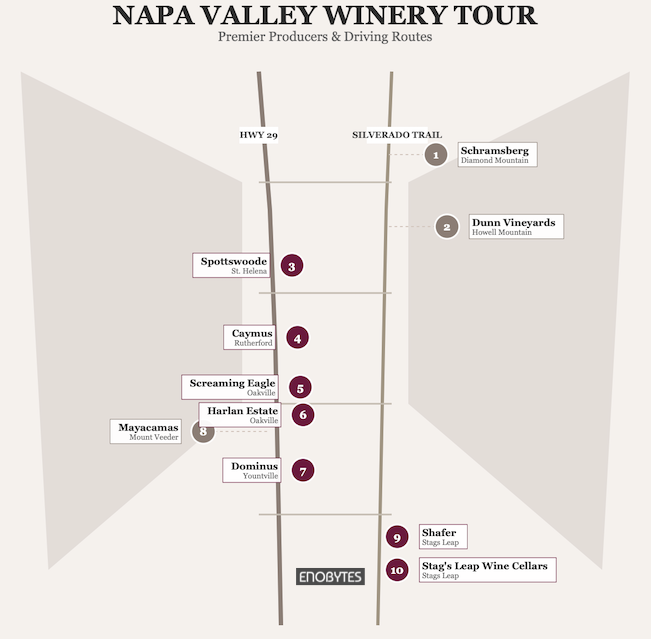 Burgundy circles = Valley floor wineries (easy access)
Grey circles = Mountain wineries (winding roads, longer drives)
ROUTE 1: Valley Floor Focus
Order: 3 → 4 → 5 → 6 → 7→ 9 → 10
→ Spottswoode (St. Helena)
→ Caymus (Rutherford)
→ Screaming Eagle & Harlan (Oakville)
→ Dominus (Yountville) → Shafer → Stag’s Leap
Driving time: ~45 minutes (without stops)
ROUTE 2: Mountain Experience
1 → 2 → 8 (+ valley selections)
→ Schramsberg → Dunn → Mayacamas
Add valley floor wineries as time permits
Est. driving time: 90+ min (winding roads without stops)
Looking for other Napa wineries? Find many more here.
What Napa Does Well (And What It Doesn’t)
Napa excels at producing age-worthy Cabernet Sauvignon from diverse terroirs. The best wines show regional character, balance power with structure, and can improve for decades. This is not a small achievement, and it’s why Napa maintains its reputation despite the prices.
Napa also produces excellent Chardonnay from cool sites, legitimate sparkling wine, and occasionally brilliant examples of other varieties. The diversity exists for those willing to look beyond Cabernet.
What Napa struggles with is restraint. The economic pressures, the critical emphasis on power and concentration, and the market’s willingness to reward bigness over balance have pushed many wines toward extremes—high alcohol, excessive oak, overripe fruit, tannins that require decades to resolve. These wines impress in tastings but overwhelm at dinner.
Napa also struggles with value. Finding a genuinely good wine under $40 is possible but increasingly difficult. The region has largely ceded the value segment to other areas and focused on luxury, which is understandable economically but limiting for consumers.
America’s most important wine region
Napa Valley remains America’s most important wine region, for better and worse. The best wines justify the reputation; the prices often don’t. The region’s beauty and history are genuine; the luxury lifestyle branding sometimes obscures both.
For serious wine drinkers, Napa deserves attention, particularly older vintages that show how these wines evolve, and wines from lesser-known producers who prioritize balance over scores. For casual drinkers, Napa can be frustrating and expensive, and other California regions often offer better value.
The maps and sub-AVAs matter because they represent genuine differences in terroir and style, though they also represent marketing opportunities and real estate values. Understanding the geography helps navigate the region’s offerings, even if it doesn’t solve the fundamental tension between quality and price.
Napa has spent fifty years establishing itself as America’s premier wine region. Whether the next fifty years see it deepen that achievement or simply extract maximum profit from its reputation remains to be seen. For now, it’s a place that produces both California’s best wines and its most expensive ones—sometimes in the same bottle, sometimes not.