

WHAT IS NOBLE ROT (BOTRYTIS) WINE?
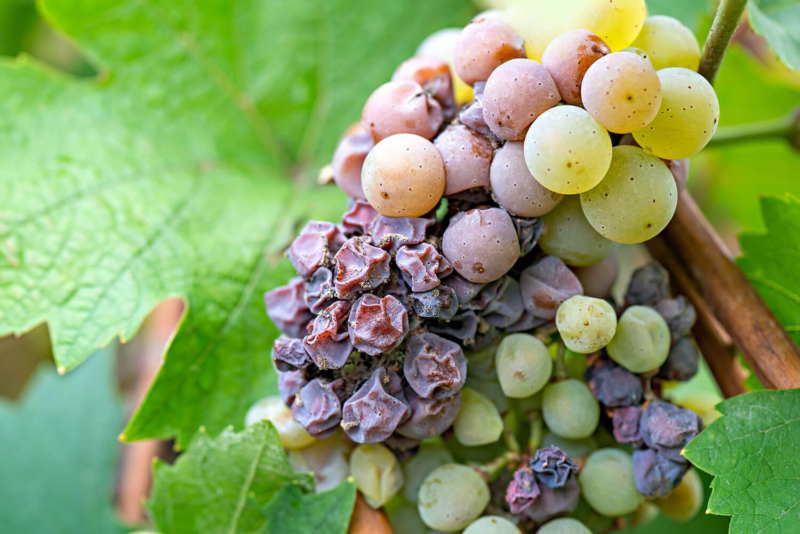
Noble Rot, also known as ‘Botrytis Cinerea’, happens when the fungus ‘botrytis cinerea’ attacks thin-skinned, very ripe grapes. It is one of the few fungal diseases welcomed into the vineyard because it allows a winemaker to produce sun kissed wines that are enticing and deliciously sweet, saturated with natural sugars.
IS NOBLE ROT THE SAME AS GREY ROT OR BUNCH ROT?
No. Both grey rot and bunch rot are destructive fungal diseases that cause sever crop loss due to excessive moisture in the vineyard, unlike noble rot, when drier conditions are at play. As the fungus dries out the grapes, they begin to shrivel like raisins, and the sugars become more concentrated. Conditions in the vineyard need to be near perfect for Noble Rot to happen. It starts with foggy, moist mornings, followed by hot, dry afternoons. If it gets too humid, it will cause grape skins to split, causing Noble Rot to fail. Since Noble Rot happens unevenly through the vineyard, it requires several passes of labor-intensive hand-harvesting over several months.
WHAT GRAPES ARE USED TO MAKE THE WINE?
- In France, most sweet wines are made using Sémillon, Sauvignon blanc, and Muscadelle grapes, which are used to make Sauternes wine in the Bordeaux region.
- In Germany and Australia, Riesling makes the Beerenauslese (BA) and Trockenbeerenauslese (TBA) sweet wines.
- In Hungary, six grape varieties are used for Tokaji wine, including Furmint, Hárslevelű, Yellow Muscat, Zéta, Kövérszőlő, and Kabar. And the premium Tokaji Eszencia is made from the free-run juice of aszú berries.
HOW ARE BOTRYTIZED WINES MADE?
Botrytis cinerea kills the yeast, so fermentation is a long, slow process requiring continuous winemaker oversight. When the wine is ready, it must go through frequent racking before it’s bottled.
WHAT DO THEY TASTE LIKE?
The wines are naturally sweet because the fermentation finishes before the fermentable sugars are converted into alcohol. Sugar levels vary from year to year, but on average, a Sauternes has 130g/l and 150g/l of sugar, which is equivalent to 2/3 cups of sugar!
Sweet wines compliment desserts, but are also perfect to pair with cheese platers and Foie Gras, providing intense aromas and delicious flavors of honey, apricot, tropical, and spicy notes.
DO ALL COUNTRIES PRODUCE BOTRYTIZED WINES?
The most well-known areas for producing botrytized wines are France, Germany, Austria and Hungary.




Leave A Comment